Abstract
Microflow chromatography on the QTRAP 6500 system provides an easy to use, high-throughput workflow for performing targeted peptide quantitation. Assays currently performed by nanoflow LC on the QTRAP 5500 system could be easily translated to the microflow QTRAP 6500 system for accelerated sample analysis with similar sensitivities.
Introduction
There has been a significant amount of research focused on discovering proteins/peptides that are differentially expressed in specific cell and disease conditions. To confirm or refute their ultimate utility, many more samples must be analyzed with increased throughput and robustness, which means faster chromatography and/or higher flow rates. At higher flow rates sensitivity may decrease due to reduced ionization efficiency compared to nanospray ionization,. Thus the best sensitivities are typically achieved using nL/min flow rates. There has been increased interest in working in the microflow regime (3-50 µL/min) to obtain a good balance between throughput, robustness and sensitivity. Coupled with recent advances in IonDrive™ Technology that provides higher sensitivity detection, microflow chromatography should provide a step forward in productivity and ease of use at a good sensitivity level.
The purpose of this study is to explore the level of sensitivity and speed of analyses achievable using two hybrid triple quadrupole linear ion trap systems operating at different flow regimes. The goal is to better understand the most efficient strategy for larger scale protein quantification studies.

Key features of the Microflow QTRAP 6500 System for peptide quantitation
-
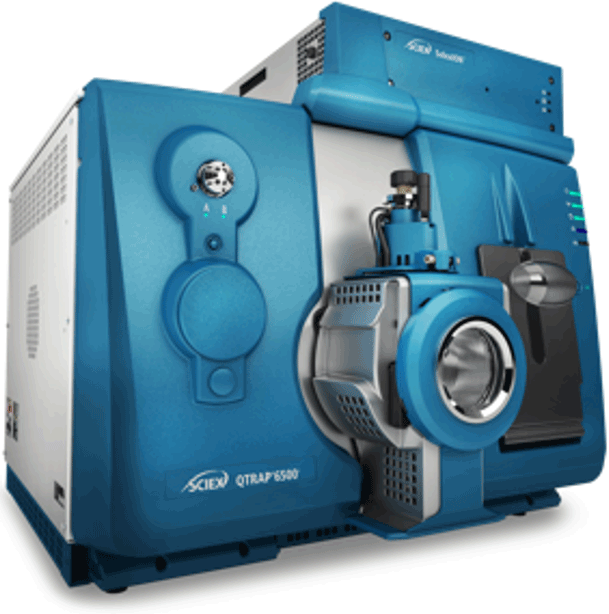
IonDrive™ Technology on the QTRAP 6500 System provides:
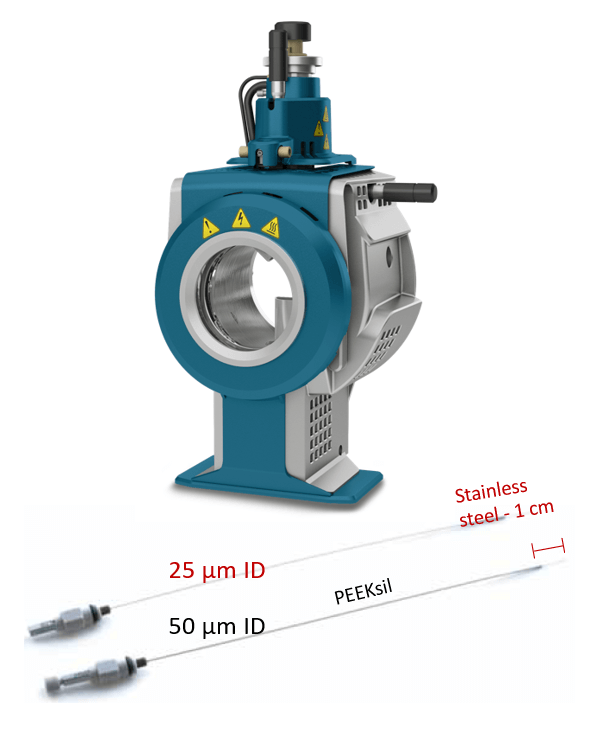
- Increased ionization efficiency and heat transfer with the new IonDrive™ Turbo V Ion Source (Figure 2)
- Increased ion sampling efficiency and ruggedness with the new IonDrive™ QJet Ion Guide
- Increased dynamic range with new IonDrive™ Detector technology
-
Mass range of m/z 5 – 2,000 provides versatility for peptide quantitation
-
The NanoLC™ 425 System has the flexibility to support a broad range of flow rates (from nano to microflow) in a single system
- Plug and Play flow modules
-
High speed autosampler enables excellent injection reproducibility with little or no sample waste
Experimental
Sample preparation: Beta-Galactosidase digest and 6 Peptide mixture was obtained from SCIEX. The Six Protein Digest was obtained from Michrom BioResources. Crashed plasma matrix was prepared by mixing equal volumes of plasma and acetonitrile, followed by centrifugation.
Chromatography: All chromatography was performed on the NanoLC™ 425 System (SCIEX), using the 0.1–1 µL/min or 1-10 µL/min flow modules. Nanoflow chromatography was performed in trap elute mode with 75 µm x 15 cm, C18 ChromXP™ columns at 300 nL/min flow rate. Microflow chromatography was performed using 300 µm x 15 cm, C18 ChromXP columns at 4 µL/min flow rate. Injection volumes used ranged from 2 – 5 µL.
Mass Spectrometry: Nanoflow LC experiments were performed on the QTRAP 5500 System with NanoSpray® Source. Microflow LC experiments were performed on the QTRAP 6500 System with IonDrive™ Turbo V Source with 25µm ID hybrid electrodes. MRM transitions were optimized for each peptide and used on both instruments. Standard concentration curves were performed to evaluate impact of flow rates and separation times on the two different MS systems. All samples were analyzed in triplicate.
Data Processing: Lower limits of quantification (LLOQ) were determined using MultiQuant™ Software.
Microflow LC for peptide quantification
When moving to higher flow rates on the QTRAP 6500 System, the IonDrive Turbo V Source provides high efficiency ionization and increased ruggedness (Figure 2). For best performance at microflow rates, the sources are plumbed with the hybrid electrodes specifically designed for microflow. These electrodes significantly reduce post column dead-volume for reduced dispersion and sharper peak widths. In this work, the 25 µm ID electrode was used, which is ideal for 300 µm ID columns and a flow rate range from 3 – 25 µL.
Previous work explored the difference in sensitivities between different nano and micro flow rates by performing standard concentration curves on a set of tryptic peptides.1 It was found that there is roughly a 3x loss in sensitivity when moving from nanoflow to the higher 4 µL/min microflow rate. Other peptide quantitation studies have measured a roughly 3-5 fold increase in sensitivity when moving from the QTRAP 5500 System to the QTRAP 6500 System. From these two studies it was hypothesized that nanoflow rate peptide quantification assays currently performed on the QTRAP 5500 System could be moved to microflow on the QTRAP 6500 System, resulting in similar sensitivities but with improved robustness and increased throughput.
Comparing the sensitivity differences across LC-MS platforms
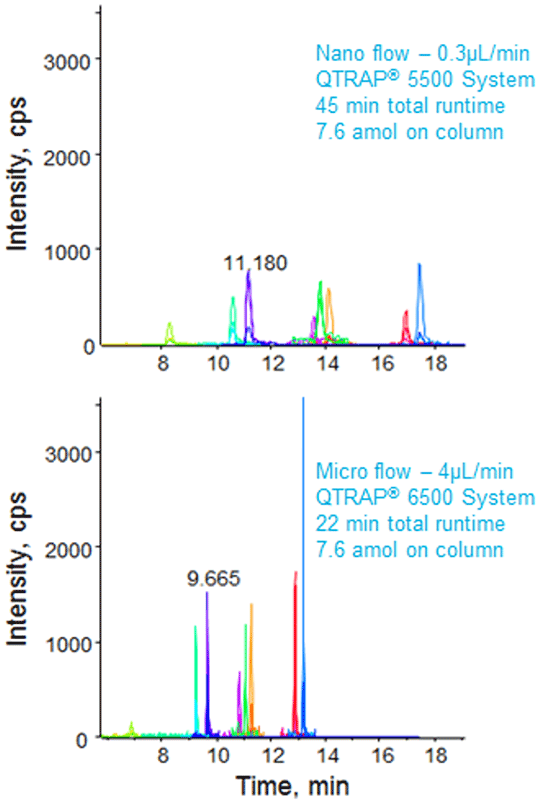
The first comparative experiment analyzed the signal intensities for a standard beta-galactosidase digest at 10 fmol on column. The signal intensities were quite comparable between the nanoflow experiment on the QTRAP 5500 System and the microflow experiment on the QTRAP 6500 System (Figure 1). The total run time was reduced by 2 fold in the microflow experiment but separation resolution was preserved.
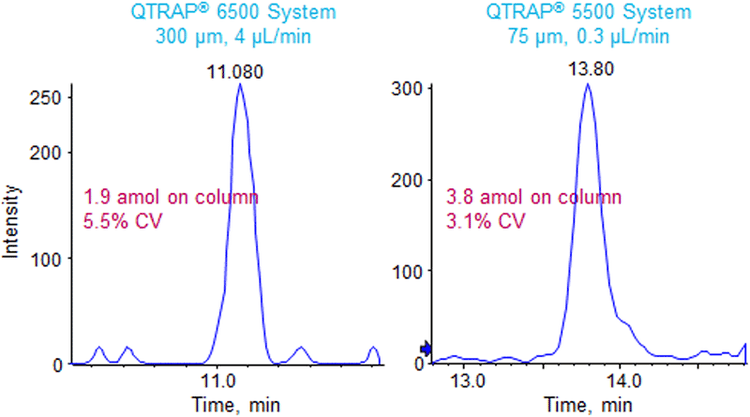
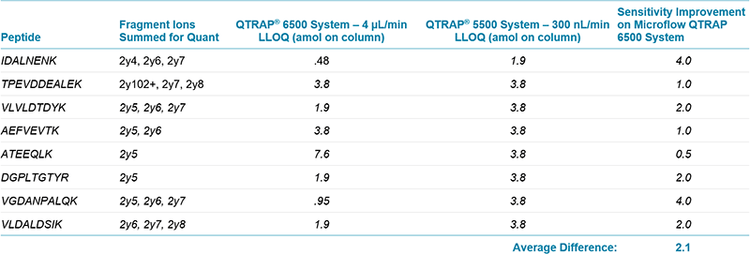
The next experiment monitored a set of tryptic peptides in a simple matrix using concentrations curves to assess sensitivity. Again, The LLOQs were determined using both LCMS systems and the results across the peptides were compared (Table 1). While some variation is observed across the peptide group, on average a 2x lower LLOQ was observed when using microflow configuration on the QTRAP 6500 System. Figure 3 shows the MRM signal difference across the 8 peptides observed by the two techniques, at an on-column concentration just above the LLOQs. Representative data is shown for one of the peptides from carbonic anhydrase (Figure 4). The LLOQ was found to be at 1.9 amol for the microflow experiment on the QTRAP 6500 System, ~2x more sensitive than that observed on the QTRAP 5500 System at nanoflow (3.8 amol on column).
The final comparison experiment was performed using the Bradykinin peptide in protein precipitated plasma. Standard concentration curves were run on both LCMS platforms and LLOQs determined. The results for the microflow experiment on the QTRAP 6500 System provided an LLOQ of about 6 amol on column (Figure 5). On the QTRAP 5500 System at nanoflow, the LLOQ was found to be 12.5 amol. Again roughly equivalent or slightly better sensitivity was achieved when using microflow on the QTRAP 6500 System.

Conclusions
The QTRAP 6500 System provides high sensitivity, excellent robustness and broad dynamic range for MRM quantification of peptides. The flexibility and reproducibility of the nanoLC 425 System makes it an ideal LC system for labs performing a broad range of proteomics workflows, which may include both nano and micro flow rate applications.
Microflow chromatography on the QTRAP 6500 System provides an easy to use, high-throughput workflow for performing targeted peptide quantitation. Assays currently performed by nanoflow LC on the QTRAP 5500 System could be easily translated to the microflow QTRAP 6500 System for accelerated sample analysis with similar sensitivities.
- Robust LC-MS with microflow rates, using both direct injection and trap-elute configurations
- Achieve nanoflow sensitivities with microflow on a QTRAP 6500 System
- Increase throughput 2X or more
- Fast, high precision autosampler for microflow chromatography
References
- Exploring the sensitivity differences for peptide quantification in the low flow rate regime - nanoLC™ 400 System for high performance nanoflow and microflow LC. SCIEX technical note RUO-MKT-02-3252-A.
Related content
- Single source solution for low flow chromatography - OptiFlow® Turbo V™ Source – Always Working in the Sweet Spot of Sensitivity and Robustness. SCIEX technical note RUO-MKT-02-9701-A.