Spotlight on: fentanyl

What is fentanyl?

Fentanyl and its analogs are members of the class of drugs known as rapid-acting synthetic opioids used for surgery, to treat patients with severe pain, or for patients with chronic pain who are physically tolerant to other opioids. Fentanyl works by binding to the body's opioid receptors, which are found in areas of the brain that control pain and emotions. Its effects include extreme happiness, drowsiness, nausea, confusion, constipation, sedation, tolerance, addiction, respiratory depression and arrest, unconsciousness, coma, and death. 

Fentanyl was first developed in 1959 and introduced in the 1960s as an intravenous anesthetic. Currently, it is legally manufactured and distributed in the United States. The problem arises when licit fentanyl pharmaceutical products are diverted through theft and fraudulent prescriptions and via illegal manufacturing and distribution. Fentanyl is also illegally manufactured and laced into illicit preparations that are distributed in powder or pill form through the illegal drug market. This process is commonly used by drug dealers to make drugs cheaper, more potent, more addictive, and more dangerous. For these reasons, the U.S. Drug Enforcement Administration classifies fentanyl and some of its analogs as Schedule II prescription drugs. On February 6, 2018, a proactive temporary (emergency) class‐wide scheduling of fentanyl‐related substances was implemented based upon the fentanyl core structure in an effort to reduce the proliferation of these hazardous substances and minimize their impact on public safety.
What are the challenges with analysis by LC-MS?

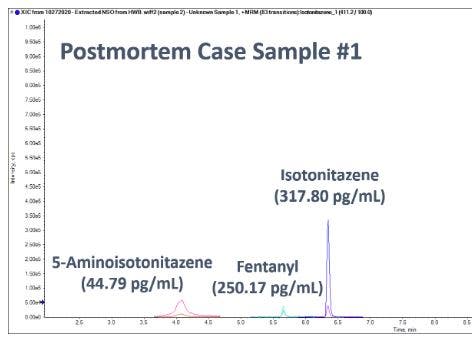
As these substances are gaining popularity as substitutes to controlled opioids and are often used as cutting agents or adulterants to heroin and other commonly abused drugs, it is imperative for forensic testing laboratories to have sensitive and accurate detection methods. But fentanyl and its analogs are structurally similar, and many are isobars, creating an analytical challenge for their detection. Traditionally, fentanyl screens are either performed by immunoassay or GC-MS. Analysis by immunoassay has considerable cross-reactivity which leads to a high rate of false positives. GC-MS requires sample derivatization and lengthy chromatographic runs to accurately identify fentanyl and its analogs. As a result, forensic laboratories have implemented LC-MS as a rapid and robust method to detect analogs and/or metabolites* with a high level of selectivity and specificity. The sensitivity and precision of LC-MS provides the ability to detect low levels of fentanyl and its analogs in authentic case samples that would normally go undetected, providing a clearer picture for help in determining the cause of overdose/death.

Why is fentanyl so interesting?

As a synthetic opioid approved for treating severe pain and aiding, fentanyl has shown clear medical benefits. However, continuous abuse of fentanyl and its derived analogs has become a major public health issue. The prevalence of accidental overdose and deaths associated with illicitly-manufactured fentanyl has risen dramatically in recent years, fueling the ongoing opioid crisis. Because fentanyl and its analogs are so potent, can be made easily and relatively inexpensively in a laboratory, and very small amounts are sufficient to supply large markets, the potency per weight ratio have made it an ideal drug to smuggle.

Using LC-MS for testing fentanyl

Timely and comprehensive analytical drug screening approaches capable of detecting fentanyl and its many analogs are critically needed in the forensic toxicology laboratory. SCIEX has collaborated extensively with thought leaders and key opinion leaders in organizations such as the Center for Forensic Science Research and Education (CFSRE) and their NPS Discovery program to develop marketing content to promote the use of LC-MS to screen, characterize, identify and quantitate these substances in a variety of biological matrices. Additionally, our team of scientists have developed a variety of workflows to showcase innovative LC-MS solutions to help forensic toxicology laboratories implement those new methods. Our technical content showcases our expertise in the analysis of these substances and demonstrates the performance of our systems to confidently detect and quantify them with high precision and accuracy. 

Some interesting facts about fentanyl

  • When prescribed by a doctor, fentanyl is administered as a shot, a patch or as lozenges that are sucked on like cough drops
  • The illegally manufactured fentanyl that has been associated with the opioid overdose epidemic currently ongoing in the US is generally found in powder form, spotted onto blotter paper, put in eye droppers or made into pills emulating other prescription opioids
  • Drug trafficking organizations typically distribute fentanyl by the kilogram.  One kilogram of fentanyl has the potential to kill 500,000 people!*
  • 42% of pills tested for fentanyl contained at least 2 mg of fentanyl, considered a potentially lethal dose*
  • Despite its risks of overdose and addiction, fentanyl is in fact an important medication for managing severe pain, particularly after surgery and for advanced-stage cancer. Research is aimed at finding safer ways to use fentanyl, minimizing its potential for abuse while maximizing its therapeutic benefits
  • Ongoing research is aimed at identifying better antidotes and treatments for fentanyl overdose, such as the development of more effective formulations of naloxone (Narcan), a medication used to reverse opioid overdoses

SCIEX, there where it counts

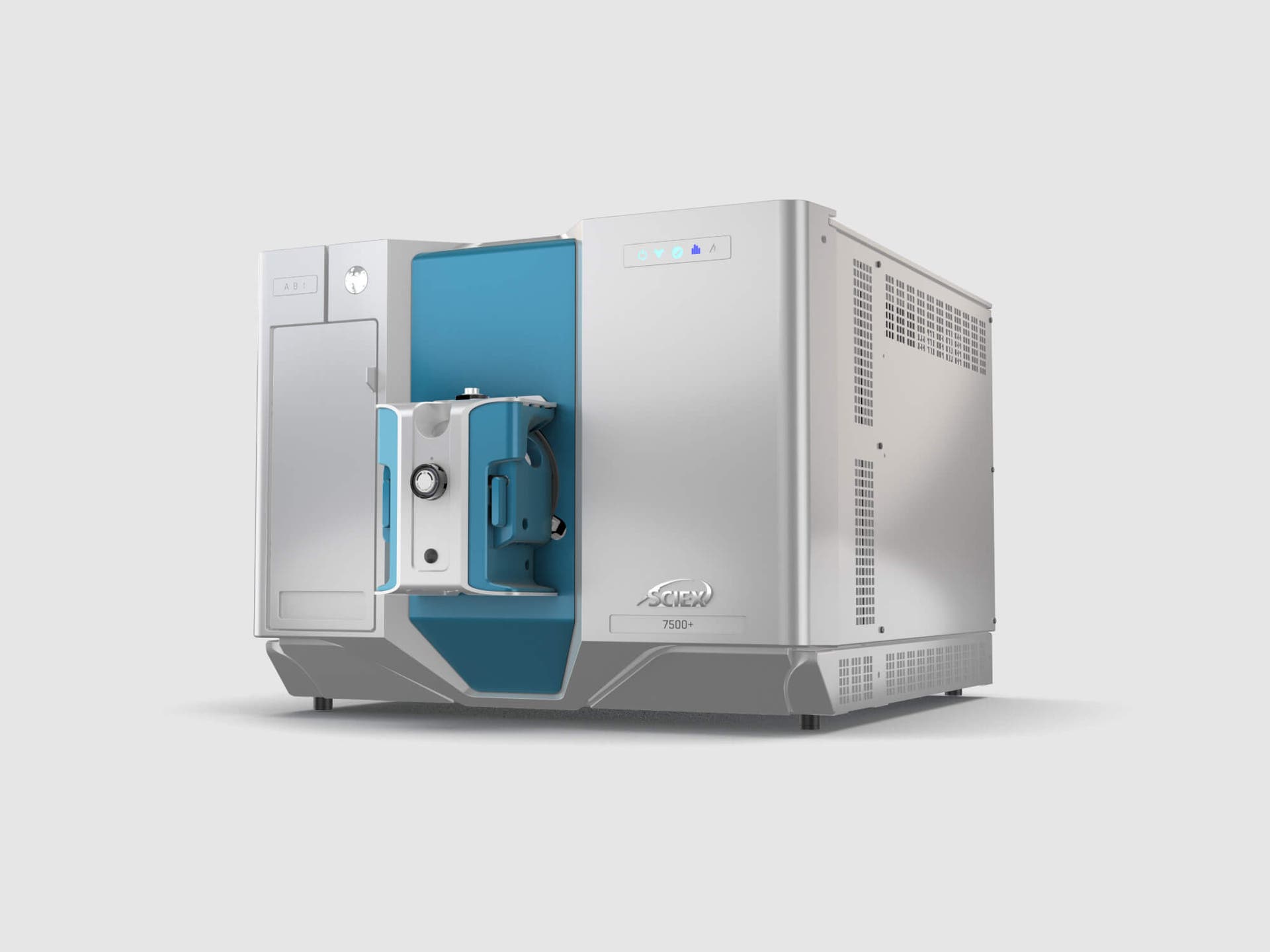
  • Unparalleled performance: exceptional sensitivity and quantitative performance of the SCIEX 7500+ system enable accurate detection of fentanyl, its analogs and their metabolites in poly-drug, authentic case samples at trace levels that were not previously achievable 
  • Biological insights: the sensitivity of the SCIEX 7500+ system provides a means to monitor low levels of ultra-potent fentanyl analogs in overdose scenarios, providing valuable insight into the causation of death 
  • Screening workflow: combining optimized LC conditions and the use of the Scheduled MRM algorithm in SCIEX OS software enables robust and sensitive quantitation and identification of isobaric species with high precision and accuracy, even at trace-level concentrations

Reaching new sensitivity levels for the detection of fentanyl analogs and highly potent novel synthetic opioids in blood

Explore more

Ebook: Novel psychoactive substances

Staying ahead of the curve screening, identifying, and quantifying with mass spectrometry

Learn more

Novel psychoactive substances (NPS) sub-application page

Explore more

Detecting low level drugs in keratinized matrices

LC-MS/MS-based methods for drug analysis in hair and nail, demonstrating the need for high-sensitivity mass spectrometry for low-level drug detection

On-demand webinar

Solution

Ultimate quantitation

Benefits:

  • Reliably quantify at low limits
  • Future-proof your methods
ExionLC AE system

Reproducibility, reliability and carryover performance to match your quantitative workflows. Dependability you can count on, from injection to injection and batch after batch.

Learn more
SCIEX 7500+ system

A new standard for instrument resilience and robustness. Engineered to maintain our highest sensitivity for up to twice as long in complex matrices.

Learn more
SCIEX OS software

Unleash the analytical power of the next-generation software platform for data acquisition and processing.

Learn more
Service

Keep your instruments performing at their peak, with multiple options for response time, repair coverage and maintenance.

Learn more

In case you missed it…

Catch up on past months topics

            Each month, the Spotlight on series will highlight a different challenging molecule or class of compounds as well as related LC-MS solutions, unmatched in terms of sensitivity and accuracy, that will help customers meet today’s and future needs.

Cyclic Peptides

Cyclic peptides are stable, bioactive molecules that resist enzymatic breakdown and can target protein–protein interactions, making them valuable for treating conditions such as autoimmune disease, transplant rejection, and inflammation. While these complex molecules are challenging to analyze, advanced LC MS platforms like the SCIEX 7500+ and 7600+ systems deliver the sensitivity and resolution needed to advance their therapeutic potential.

Learn more
SCIEX OS software

SCIEX OS software streamlines instrument control and automates data processing to simplify lab workflows and support fast, informed decisions. It serves both new and experienced users by maintaining compliance through audit trails and role-based access, while automating routine tasks so scientists can focus on discovery. Designed for all the latest SCIEX mass spectrometry systems and now enhanced with Windows 11 support to meet IT security policies and reduce cybersecurity risks.

Learn more
GLP-1

GLP-1 is a multifaceted hormone that regulates blood glucose, influences appetite and weight, and provides cardiovascular benefits. Continued research and development of GLP-1-based therapies promise to advance and expand potential uses. The sensitivity, specificity, and versatility of LC-MS plays a major role in advancing GLP-1 research with new insights.

Learn more
Bile acids

Bile acid biochemistry was once poorly understood, but growing interest in the gut-brain axis and microbiome has sparked new research. LC-MS technology is advancing knowledge of bile acids' roles and potential as therapeutic targets and biomarkers.

Learn more
Fentanyl

Fentanyl has garnered significant attention in recent years due to its critical role in both medical and illicit contexts. As a compound, it offers unparalleled pain relief, but also contributes to an alarming rate of opioid-related overdoses. Studying fentanyl is essential to developing effective therapeutic applications, understanding its pharmacokinetics, and addressing the public health crisis it poses. LC-MS/MS has emerged as a transformative technology in advancing fentanyl research, providing precise and comprehensive analytical capabilities.

Learn more
Oligonucleotides

Oligonucleotides are pivotal in genetic research, diagnostics, and therapeutics. Explore the intricacies of these molecules and how LC-MS technologies are propelling their research to new heights, enabling scientists to achieve exceptional levels of accuracy in oligonucleotide characterization and quantitation.

Learn more
Lipid mediators

The third topic in the Spotlight on series explores lipid mediators, a highly potent family of signaling molecules, perhaps best known for their role in inflammation. Due to their potent biological activities and often transient existence, precise and sensitive analytical techniques are essential for their study.

Learn more
Nitrosamines

Get a deeper understanding of what makes nitrosamines a concern, what is being done to understand and test for nitrosamines, and how SCIEX LC-MS solutions can help give you confidence in your quantitation needs: for today and tomorrow.

Learn more
PFAS

PFAS are an extensive, complex group of manufactured chemicals that are ubiquitous throughout the environment, accumulate from many different sources and whose consumption is currently unavoidable. With accumulating toxicity a rising concern, sensitive and resilient analysis is key to understanding exposure risks. LC-MS is considered the gold standard for detecting and quantifying PFAS molecules and has become the “defacto” methodology for analysis.

Learn more
Targeted protein degraders

The second topic in the Spotlight on series covers targeted protein degraders (TPDs), a cutting-edge approach in the field of drug development. By leveraging an event-driven mechanism that degrades unwanted or harmful proteins, rather than the traditional occupancy-driven approach, TPDs offer several significant therapeutic benefits that make them particularly promising for treating challenging conditions.

Learn more